If you’re going into the mountains we can’t stress enough the importance of carrying a whistle with you. They can save lives.
Should you get lost in low cloud (or even just separated) and need to shout for help so that people can find you, your voice won’t carry particularly far and nor will it last that long before you go hoarse. But you can blow on a whistle for hours on end, if necessary.
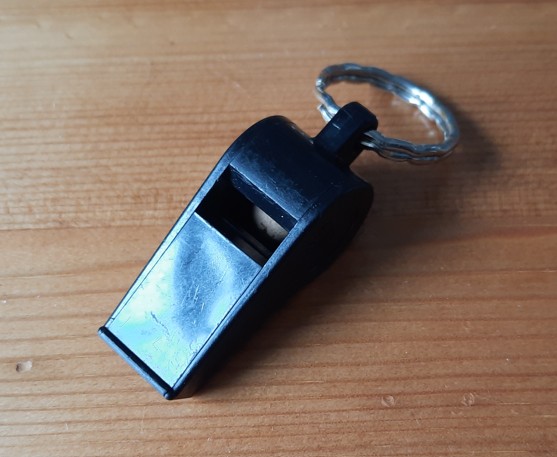
Some rucksacks these days have an integral plastic, thin whistle, but they’re not very good because they’re just not very loud. We recommend buying a traditional ‘pea’ whistle, such as in the picture below. They can be made of metal or plastic and you can buy them for under a fiver.
A good whistle is the renowned ‘Acme Thunderer’. Since its invention in 1884, it has become the gold standard for reliability: officers on the Titanic were issued with Acme Thunderers and, in fact, one was recovered from the wreckage, still functional; during WWI, officers in the trenches used them for the “over the top” command due to its clarity and volume; and it was the first whistle used at an FA Cup Final (1884) and remains the most used whistle by professional referees today.
In the UK the standard distress signal for requiring help is 6 shorts blasts of a whistle (or flashes of a torch if it’s dark), followed by a minute’s gap (to listen for a response) before following it with another 6 blasts. If someone hears you, they will return your whistle with 3 short blasts.
Even if someone has signalled a response, or if you know help is on the way, the casualty should continue signalling with their 6 blasts until help actually reaches them. This helps with tracking their exact location, as sound can bounce off crags and be very deceptive.
Buy one and keep it in your rucksack. You only need to buy it once and you’ve got it for life. A certain Prime retailer can get one to you tomorrow!
Don’t underestimate the benefit of a whistle. There have been instances on Snowdon where lives could have been saved with a whistle. Cases where people got lost in thick fog, strayed well off the path and then night fell. Although the rescue services were out looking for them, they never found them until the next day, by which time they had died from hypothermia; it was winter. A whistle could have enabled the rescue services to find them.
Of course, you don’t have to stop at a whistle. Aside from a phone and spare power bank, a torch and a foil blanket are only a couple of other things which can prove invaluable.